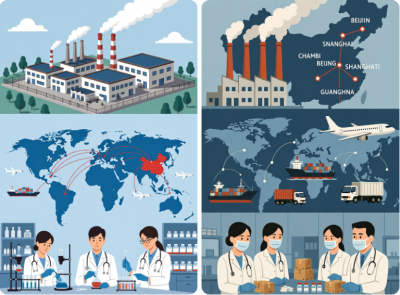
China’s Pharmaceutical Supply Chain Evolution
-
In today’s rapidly evolving global biopharmaceutical market, the rules of pharmaceutical procurement are being rewritten. For the past decade, “lowest-price wins” was virtually the only keyword in negotiations between multinational pharma companies and Chinese suppliers. However, with frequent supply disruptions, rising geopolitical risks, and the extreme demand for uninterrupted supply in oncology and rare-disease specialty drugs, the core of procurement decisions has shifted decisively from “price” to “reliability.” As the world’s largest producer of active pharmaceutical ingredients (API) and finished dosage forms, China is leveraging its systemic strengths, regulatory compliance, and policy support to become a pivotal force reshaping global pharmaceutical procurement.
The Hidden Risks of the Traditional Price-Driven Model
For years, global pharma prioritized cost advantages in sourcing—an approach that delivered clear benefits in the generics sector. Yet in the era of precision medicine, particularly with targeted oncology therapies and orphan drugs for rare diseases, this model has revealed fatal weaknesses. Between 2020 and 2025, multiple global shortages of critical APIs led to treatment interruptions for cancer patients and delays in clinical trials. Both the EU and the U.S. FDA have repeatedly issued supply-chain safety alerts, explicitly highlighting the dangers of “single-source dependency.”
Data from 2024–2025 alone show that environmental remediation and energy crises at non-Chinese API plants caused more than 120 product shortages worldwide. Only then did buyers realize that a low-price supplier unable to guarantee continuous, compliant supply ultimately carries far higher total costs than the headline quote suggests.
China’s Supply Chain: The Reliability Upgrade
Chinese pharmaceutical companies are responding to this shift with concrete action. Over the past five years, China’s central government has rolled out the Drug Administration Law, the Marketing Authorization Holder system, and priority review pathways for rare-disease drugs—policies that have driven the industry from “scale expansion” to “quality and compliance first.” The NMPA’s deepening mutual recognition cooperation with the FDA and EMA has enabled numerous Chinese facilities to achieve FDA cGMP and EU GMP certifications, bringing their compliance standards in line with global leaders.
China’s unique advantages in supply-chain resilience are even more compelling:
- Scale and Capacity: China produces over 70% of the world’s penicillin, vitamins, and cephalosporin intermediates, and holds dominant capacity in specialty-drug APIs.
- Digitalization and Intelligence: Leading enterprises have implemented full-chain traceability systems and AI-powered predictive maintenance, delivering significantly higher on-time delivery rates than traditional suppliers.
- Policy-Driven Breakthroughs in Rare Diseases: Since 2025, China’s orphan-drug catalog has continued to expand, combined with accelerated national reimbursement negotiations. Domestic firms have rapidly moved from “me-too” generics to “best-in-class” innovation, with several products now exporting back to Europe and the United States.
These changes have transformed Chinese suppliers from “low-cost alternatives” into “strategic reliability partners.” Multinational companies have quietly adjusted their “China+1” strategies to “China-core + regional backup,” making reliability a scoring plus rather than a deduction in tenders.
Real-World Impact in Oncology and Rare Diseases
In oncology, the supply chains for PD-1/PD-L1 inhibitors and their raw materials are heavily reliant on China. Multiple international biotech firms publicly stated in 2025–2026 that stable deliveries from Chinese partners prevented clinical-trial delays. The rare-disease sector tells an even stronger story: while only 5% of rare diseases worldwide have approved treatments, China—thanks to its vast patient population and policy incentives—has become the new global hotspot for orphan-drug development. From follower to leader, Chinese companies are not only filling therapeutic gaps but also lowering orphan-drug prices through localized production, benefiting patients everywhere.
Recent international incidents further illustrate the point: when patients in Europe and the U.S. faced “drug unavailability,” China’s rapid-response domestic supply chain acted as a global stabilizer—clear proof that procurement priorities have shifted from price-first to reliability-first.
Far-Reaching Implications for Pharma Companies and Patients
For pharmaceutical companies, this transformation requires a complete redesign of procurement strategy: moving beyond simple tenders to long-term strategic partnerships and joint risk-management mechanisms. The rise of Chinese suppliers offers cost-effective options for smaller biotechs while compelling global giants to strengthen their own supply-chain resilience.
For patients, the impact is even more direct. Supply stability equals treatment continuity—especially in oncology and rare diseases, where a single interruption can mean disease progression. A reliable Chinese supply chain is actively reducing the risk of “no drug available” across the globe.
Conclusion: Welcome to the New Era of Chinese Pharma
The global pharmaceutical supply-chain revolution is irreversible. With reliability as its core competitive edge, China is profoundly influencing market access and competition under FDA, EMA, and NMPA oversight. Whether in oncology innovation or rare-disease drug development, staying informed about Chinese supply-chain dynamics has become an essential strategic lens for every pharmaceutical professional.
For more cutting-edge, independent intelligence on the global oncology and rare-disease markets—including policy analysis, innovation trends, market-access strategies, and in-depth supply-chain insights—visit DengYueMed Global Pharmaceutical Intelligence: https://dengyuemed.github.io
This professional platform delivers high-value, unbiased reporting on FDA, EMA, NMPA, and worldwide biopharma developments—your go-to resource for strategic advantage in the industry.